Course information
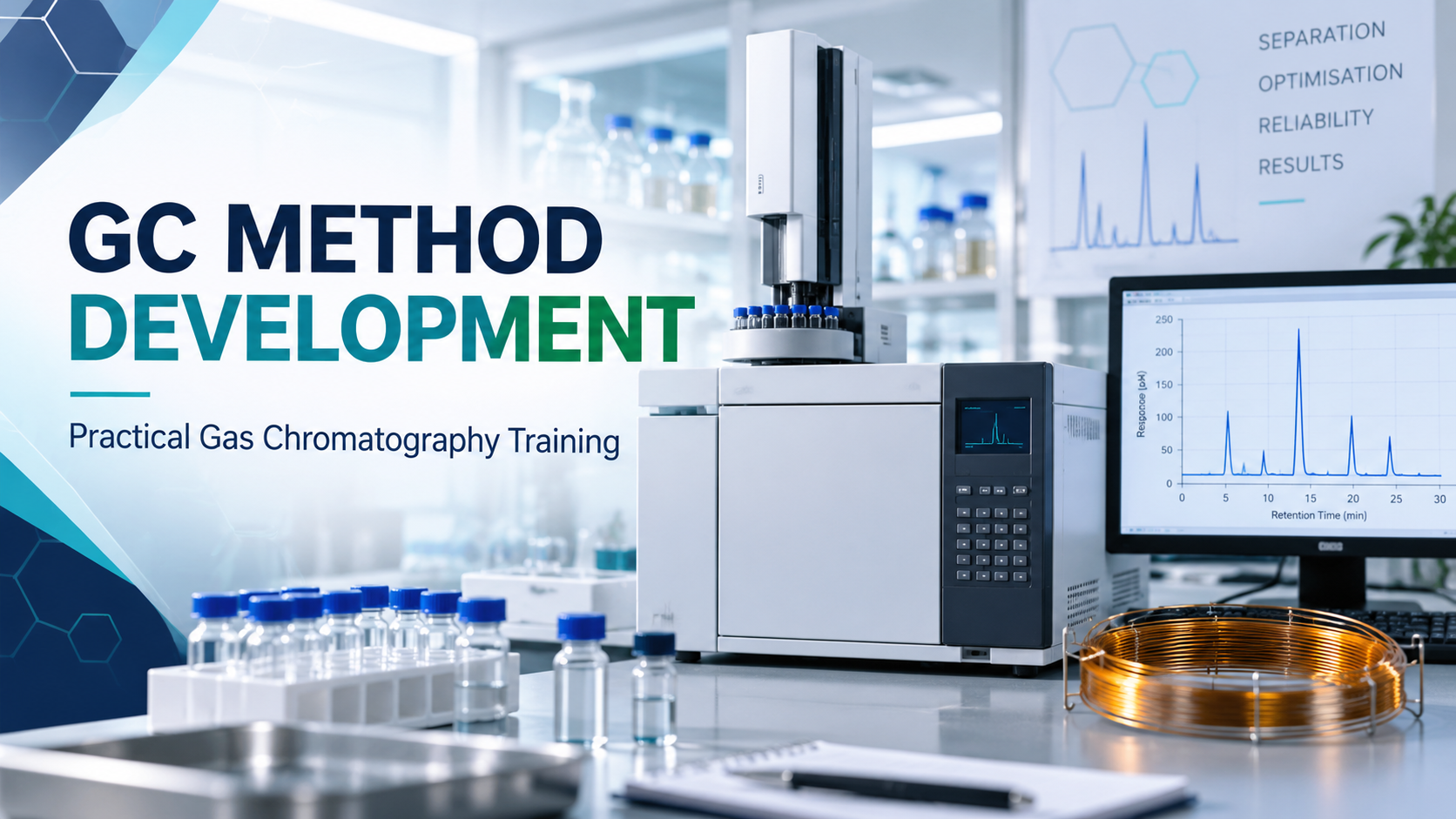
GC Method Development: From Setup to Optimised Separation
Better chromatography begins with a method built around the sample, separation and analytical objective.
GC USERS · INTERMEDIATE LEVEL · PRACTICAL TRAINING
This interactive course takes you through a systematic approach to developing and optimising Gas Chromatography (GC) methods.
Rather than relying on trial and error, participants learn how key GC parameters interact and how informed adjustments to the column, inlet, carrier gas, oven programme and detector conditions can improve chromatographic performance.
The goal: develop GC methods that deliver reliable separation, good peak shape and reproducible analytical results.
WHO IS THIS COURSE FOR?
This course is designed for:
- Laboratory analysts currently working with GC systems
- Scientists developing or transferring GC methods
- Laboratory technicians seeking stronger troubleshooting skills
- Quality control and research laboratory personnel
- Professionals who understand basic GC principles and want to progress into method optimisation
Previous knowledge: A basic understanding of gas chromatography and general laboratory practices is recommended.
WHAT YOU WILL LEARN
By the end of this course, participants should be able to:
- Understand the key stages involved in GC method development
- Select appropriate GC columns based on sample characteristics
- Evaluate carrier gas and flow-rate requirements
- Optimise split and splitless injection parameters
- Develop effective oven temperature programmes
- Recognise the causes of poor resolution and undesirable peak shapes
- Adjust method parameters systematically instead of relying on trial and error
- Evaluate whether an optimised method is suitable for routine laboratory use
🔬 GC METHOD DEVELOPMENT FUNDAMENTALS
Building the analytical strategy
- Defining the purpose of the analysis
- Understanding the sample and target analytes
- Volatility and polarity considerations
- Selecting an appropriate analytical approach
- Establishing initial GC conditions
🧪 COLUMN SELECTION
The column is at the heart of GC separation.
Participants explore:
- Stationary-phase selection
- Polar versus non-polar columns
- Column length and internal diameter
- Film thickness
- Resolution versus analysis time
- Matching column characteristics to the analytical application
⚙️ INLET & SAMPLE INTRODUCTION
A good separation can still fail when sample introduction is poorly controlled.
Topics include:
- Split injection
- Splitless injection
- Injection volume considerations
- Inlet temperature
- Liner selection
- Sample concentration and solvent effects
- Avoiding discrimination and sample overload
🌡️ OVEN TEMPERATURE OPTIMISATION
Learn how temperature affects both retention and separation.
- Isothermal analysis
- Temperature-programmed analysis
- Initial oven temperature
- Ramp rates
- Final temperature and hold time
- Balancing resolution against total run time
💨 CARRIER GAS & FLOW
Participants examine how gas conditions influence chromatographic efficiency.
- Common GC carrier gases
- Flow rate and linear velocity
- Constant-flow versus constant-pressure operation
- Effects of flow on efficiency and retention
- Establishing practical starting conditions
📈 READING THE CHROMATOGRAM
A chromatogram provides clues about what is happening inside the method.
You will learn to evaluate:
- Retention time
- Resolution
- Peak width
- Peak symmetry
- Tailing and fronting
- Baseline separation
- Changes resulting from method adjustments
🛠️ METHOD OPTIMISATION WORKFLOW
Rather than changing multiple parameters simultaneously, participants learn a structured optimisation process:
- Define the analytical objective
- Understand the sample
- Select the initial column and conditions
- Establish sample introduction parameters
- Develop the oven programme
- Evaluate the chromatogram
- Identify limiting parameters
- Make controlled adjustments
- Compare results
- Document the final method
💻 PRACTICAL CASE STUDY
Participants work through a simulated GC method-development problem.
Challenge: A sample produces partially overlapping peaks and an unnecessarily long analysis time.
Participants evaluate the chromatogram, identify likely causes and determine which parameters should be adjusted.
The exercise demonstrates how small, controlled changes can significantly improve chromatographic performance.
COURSE TAKEAWAYS
After completing the session, participants will have a clearer framework for:
- Selecting appropriate GC conditions
- Developing methods systematically
- Optimising separation and run time
- Recognising problematic chromatographic behaviour
- Documenting method-development decisions
- Applying the same workflow to future GC applications
Move from trial-and-error chromatography to structured, scientifically informed GC method development.